
Vegetable Shortening for Bakery, Biscuit & Food Manufacturing
Vegetable shortening for tenderizing in bakery and biscuits, frying stability and industrial formulations — a versatile fat input supplied in bulk.

What Is Vegetable Shortening?
Shortening is one of the most versatile fat inputs in commercial food production. Its name describes its core function: “shortening” a dough by coating flour proteins and limiting gluten development, which produces the tender bite and crisp structure consumers expect from biscuits, cookies and pastries.
The product family spans several application classes. In biscuit and cookie production, shortening controls spread, snap and texture on industrial lines. In bakery, it contributes tenderness and volume. In frying applications, it is selected for stability under heat. In broader food manufacturing, it serves as a formulation fat where a consistent, specification-driven input is required.
For B2B buyers, shortening is typically evaluated against the specific application it will serve — the right shortening for a biscuit line is not necessarily the right one for frying. Meridian Food Fats supplies the product family in bulk export formats, with the verified specification for the quoted product issued alongside each quotation.
Procurement teams comparing shortenings should also weigh logistics: bulk format, container loading and destination documentation all affect landed cost and handling. These details are confirmed per enquiry, together with the specification, so the evaluation reflects the actual order rather than generic category claims.
Typical Applications
Vegetable Shortening is selected for the following application areas. Application suitability for a specific process is confirmed during the enquiry.

Who Buys Vegetable Shortening
Vegetable Shortening is supplied to commercial buyers across these segments. See the full overview of industries we serve.
- Biscuit manufacturers
- Food manufacturers
- Commercial bakeries
- Ingredient distributors
- Foodservice businesses
Product Characteristics
The parameters buyers typically evaluate for vegetable shortening. Verified values are issued with each quotation and are never published unverified.
| Parameter | Relevance to buyers | Value |
|---|---|---|
| Product form | Handling, dosing and incorporation on production lines | Available on request |
| Fat content | Formulation cost and functional performance | Available on request |
| Melting characteristics | Spread, snap and texture in baked products | Available on request |
| Stability | Behaviour in frying and long-shelf-life applications | Available on request |
| Application suitability | Biscuits, bakery, frying and food manufacturing formulations | Available on request |
| Packaging | Handling, storage and container planning | Available on request |
| Net weight | Yield and production planning | Available on request |
| Shelf life | Stock rotation and distribution planning | Available on request |
| Storage conditions | Warehouse and transport requirements | Available on request |
Specification values are issued with each quotation and are never published unverified.
Packaging
Shortening is supplied in bulk formats suited to production-scale handling and export shipment. Packaging options are confirmed according to product and order requirements, with format, net weights and container loading details issued together with each quotation.
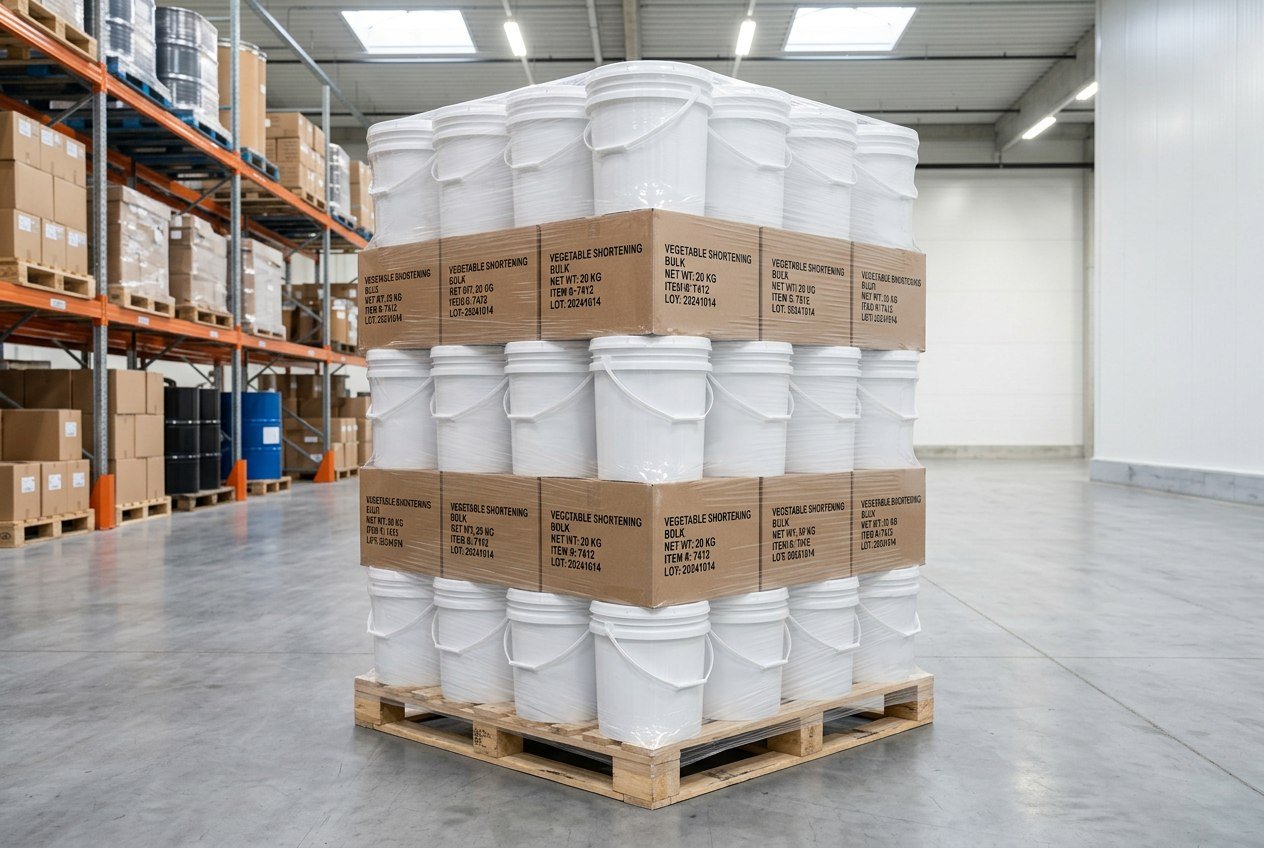
Packaging options are available according to product and order requirements — no packaging format is claimed without verification.
Storage
Shortening should be stored in cool, dry conditions away from heat and strong odours, and rotated on a first-in-first-out basis. Verified storage parameters and shelf-life details for your order accompany the product specification.
Export & Supply
Shortening is supplied through the Meridian Food Fats international network, with supply and commercial relationships connected to Thailand, the United States and Canada. Export shipments include documentation prepared per destination market and container loading plans for 20ft and 40ft containers.
Buyer Considerations
- Define the primary application — biscuit and cookie production, bakery, frying or general formulation — because shortening grades are application-driven.
- Evaluate behaviour on the actual production line, including spread, snap or frying stability as relevant.
- Request the verified specification for the quoted product rather than comparing generic shortening claims.
- Align packaging format and container quantities with consumption or distribution planning.
Related Products
Related Applications
Further Reading
Vegetable Shortening — Buyer Questions
What is shortening used for?
Shortening is used in biscuit and cookie production, bakery, frying applications and general food manufacturing, where it tenderizes, controls texture and serves as a formulation fat.
What is the difference between shortening and margarine?
Shortening is a fat ingredient focused on tenderizing and functional performance, while margarine is an emulsified fat product formulated for specific bakery and food applications. Selection depends on the role the fat plays in the finished product.
Can shortening be supplied in bulk?
Yes. Shortening is supplied in bulk export formats for manufacturers and distributors, with packaging and quantities confirmed per enquiry.
How do I choose the right shortening?
Start from the application and process. Describe the product being made and the line it runs on in a quote request, and the appropriate shortening can be recommended.